Math Monthly

717 posts

Math Monthly Update | Slight Changes to the Schedule and Membership Rates

Welcome to Math Monthly! I host live Zoom problem-solving sessions for members every morning between 4 and 8 a.m. Central Time.

Sunday is still for basic/beginner members.

We work through algebra, trigonometry, precalculus, differential calculus, integral calculus, multivariable calculus, differential equations, linear algebra, physics mechanics, electromagnetism, and basic probability and statistics. We may also cover computer programming and chemistry.

Members who attend live can request topics in the Zoom chat. When there are no live requests, I pull from the website Q&A or choose topics to build out the Math Monthly lesson library.

Advanced Research meets Tuesday, Thursday, and Saturday afternoons for two to four hours. Advanced Research members receive an email one to two hours before each session goes live.

Subscribe for lessons and visit MathMonthly.com to join the live Zoom sessions.

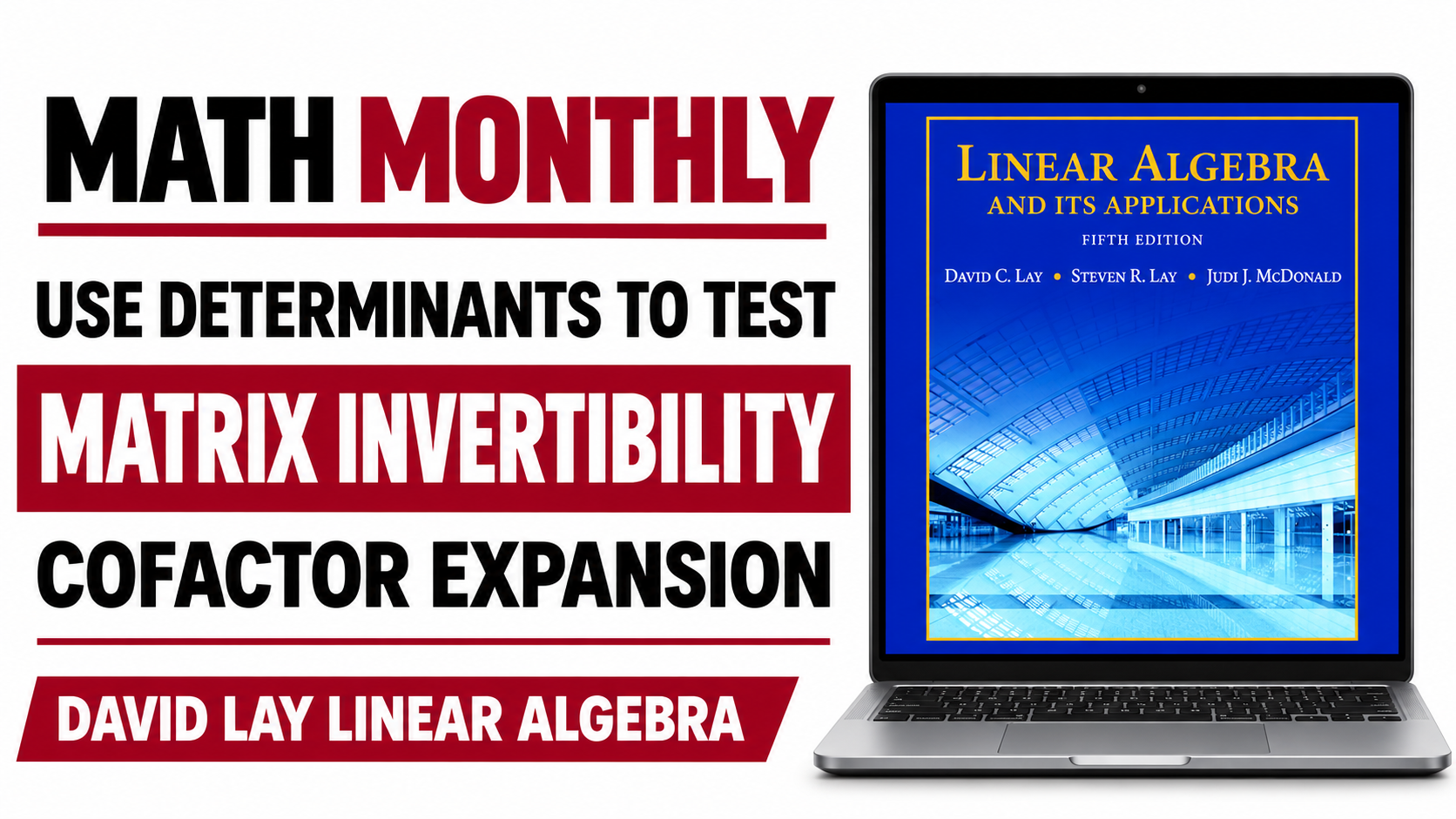
Use Determinants to Test Matrix Invertibility | Cofactor Expansion | David Lay Linear Algebra

By Author Jonathan David Linear Algebra: Use determinants to find out if the matrix is invertible. [12] Lay, D. C., Lay, S. R., & McDonald, J. J. (2016). Linear algebra and its applications (5th ed.). Pearson. https://broman.dev/download/Linear%20Algebra%20and%20its%20Applications%205th%20Edition.pdf QUESTION 3.2.23 Use determinants to find out if the matrix is invertible. $$ […]

The Big Book of STEM & PLEM | Quartic Play vs. the Red Edition

I wrote two hardcover editions of The Ultimate Crash Course to show undergraduates how to read a textbook, write a complete solution, and explain why each step works. In this livestream, I flip through both editions and explain which one fits where you are in college.

• Quartic Play is for STEM students working through calculus and preparing for linear algebra, differential equations, and physics. It includes the Daily Dose, a collection of short readings on college study habits and staying motivated.

• The Red Edition is for PLEM students preparing for upper-level math, physics, and engineering. In place of the Daily Dose, it includes more than 200 pages of professionally written solutions covering topics such as index notation, Maxwell’s equations, and introductory quantum mechanics.

Both hardcovers include PDF access and a video library with podcasts and recordings of me writing the book in Microsoft Word. You can see how I cite the textbook, format equations, and verify a solution so you can practice those skills on your own.

Compare the two editions at https://mathmonthly.com

Get full access and perks when you become a member @MathMonthly via https://www.youtube.com/@TheAuthorJonathanDavid/join

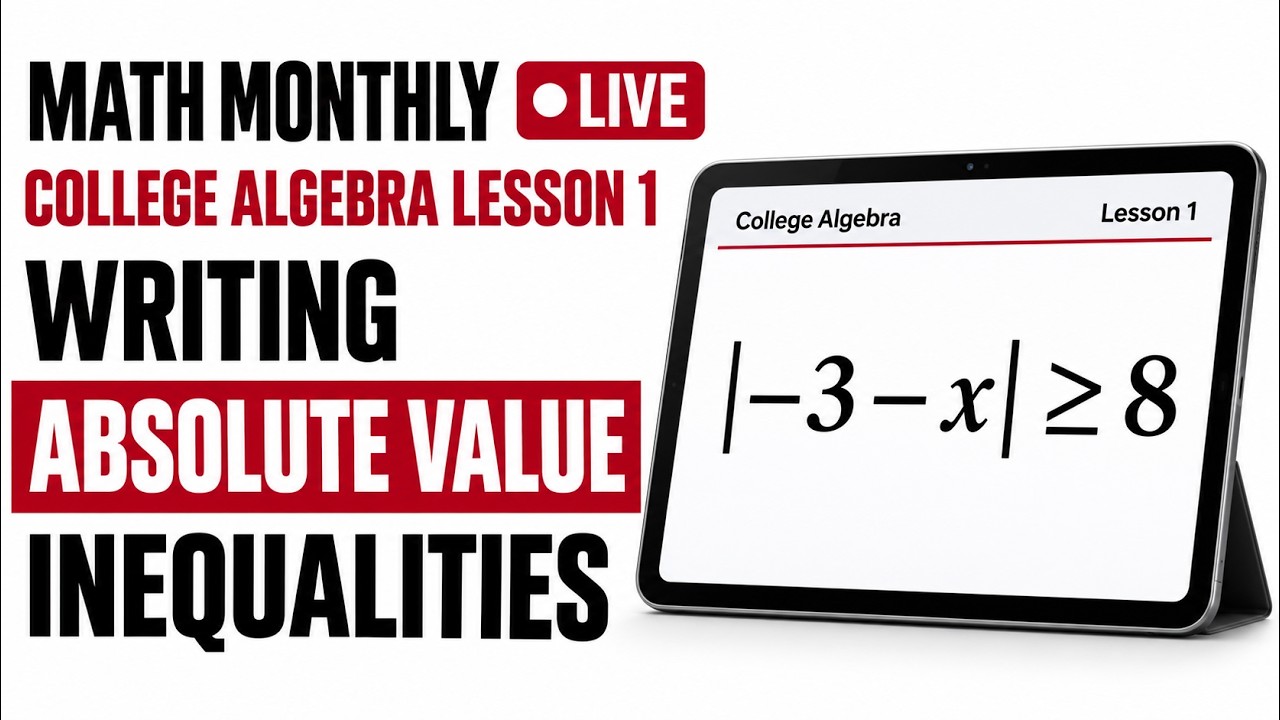
College Algebra Lesson 1 | Absolute Value Inequalities & Math for Adults

How do you turn “the distance between x and −3 is at least 8” into an absolute value inequality? In this Math Monthly livestream, I open the first lesson in the College Algebra library and show how to find the textbook’s definition of distance, translate “at least” into the correct inequality symbol, and write the solution in Microsoft Word with a citation.

I also talk about returning to math as an adult. A good starting point is to explain why each step works and then try the same method on a new problem. I show how that approach carries from a short algebra exercise into the longer solutions we write for the Math Monthly Journal.

Beginner PLEM Research meets on Sundays. Advanced PLEM Research meets on Tuesdays and Thursdays. Members can revisit recorded sessions and request topics through the website.

Explore the lesson library and research memberships at https://mathmonthly.com

Get full access and perks when you become a member @MathMonthly via https://www.youtube.com/@TheAuthorJonathanDavid/join

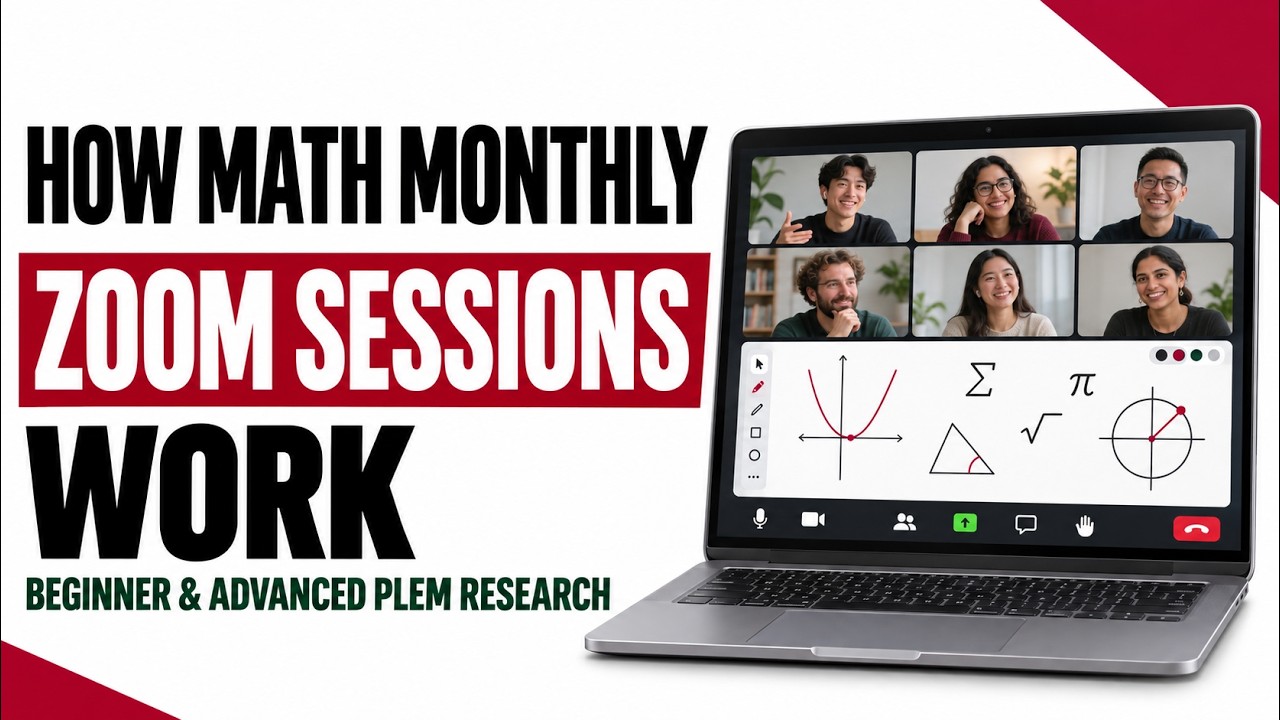
How Math Monthly Zoom Sessions Work | Beginner & Advanced PLEM Research

What happens in a Math Monthly Zoom session? In this morning livestream, I explain how the beginner and advanced groups work, who can join the morning sessions, and how to request a lesson on a textbook section you’re working through.

• Beginner PLEM Research meets on Sundays. Bring a topic you’re stuck on, whether it’s logarithmic functions in precalculus, linear algebra, differential equations, or introductory physics. I’ll use a textbook example to show you how to approach the topic so you can work through the next problem independently.

• Advanced PLEM Research meets on Tuesdays and Thursdays. We choose a problem from an advanced math, physics, or engineering text, unpack the notation, and document the solution for the Math Monthly Journal. Advanced members can also join occasional morning Zoom sessions while I develop lessons and work through problems.

I also share how The Hallway began as a series of voice messages recorded while I played fetch with my dog in the hallway that inspired the book.

Explore the research memberships at https://mathmonthly.com

Get full access and perks when you become a member @MathMonthly via https://www.youtube.com/@TheAuthorJonathanDavid/join

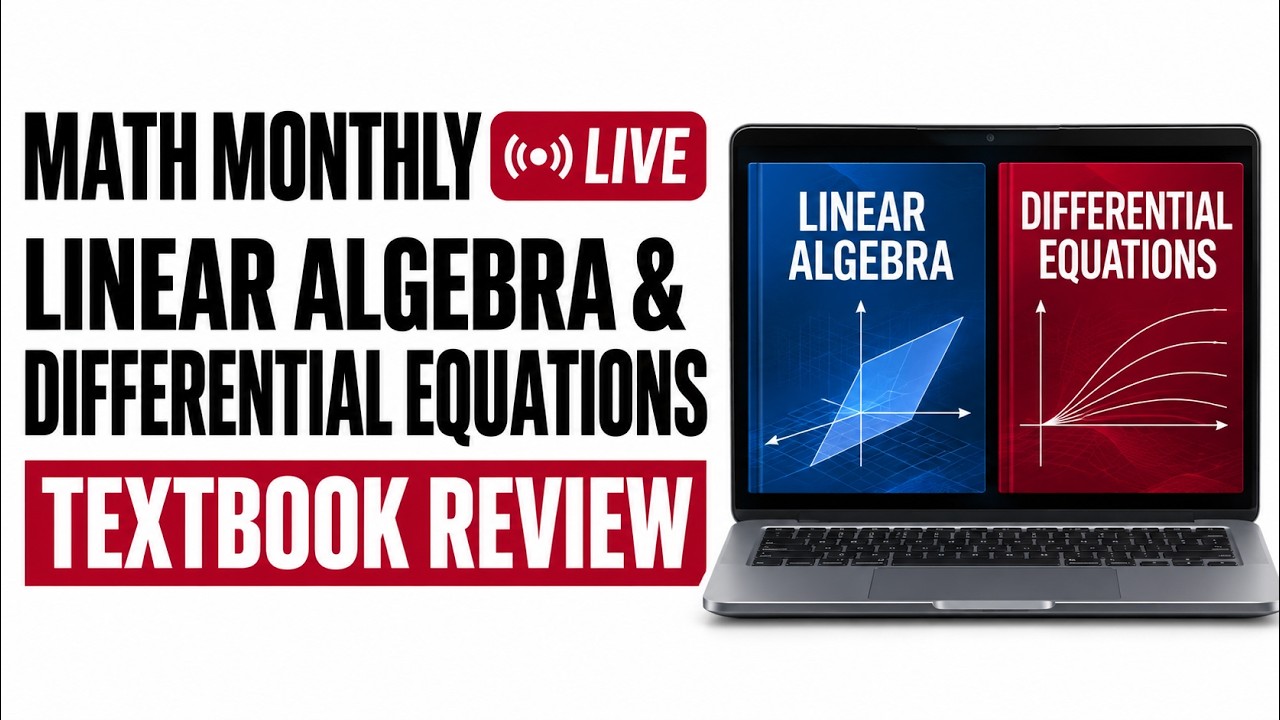
Linear Algebra & Differential Equations Textbook Review | Math Monthly LIVE

How do you tell whether a symbol represents a scalar, a vector, or a matrix? In this livestream, I compare David Lay’s and Gilbert Strang’s linear algebra textbooks and show how typography, definitions, and the surrounding equation help you interpret the notation. A bold zero is a good example of why context matters.

Then I review differential equations textbooks, including Dennis Zill’s, and show how to classify an equation before choosing a solution method. I discuss reduction of order, Cauchy–Euler equations, constant coefficients, and the difference between homogeneous and nonhomogeneous linear equations. If your engineering course combines linear algebra and differential equations, I also explain how to use a worked example from lecture to practice a related case on your own.

I also preview how we work through textbook problems together in Beginner and Advanced PLEM Research and document our solutions for the Math Monthly Journal.

Explore the lesson library and research memberships at https://mathmonthly.com

Get full access and perks when you become a member @MathMonthly via https://www.youtube.com/@TheAuthorJonathanDavid/join

Page 2 – The Copyright Page – How to Get a Job at NASA Before Graduation | PLEM Academy

Follow along as I format the copyright page for my textbook, How to Get a Job at NASA Before Graduation, in Microsoft Word. I show how I use a two-column table to organize the copyright notice, permissions information, publication details, and a statement explaining the book’s relationship to NASA.

This is the second page of my PLEM Academy book project. Use the layout as a starting point for your own book and adapt the publication details to your project.

Explore PLEM Academy at https://mathmonthly.com

Get full access and perks when you become a member @MathMonthly via https://www.youtube.com/@TheAuthorJonathanDavid/join

Page 1 – The Cover Page – How to Get a Job at NASA Before Graduation | PLEM Academy

Follow along as I create the cover page for How to Get a Job at NASA Before Graduation in Microsoft Word. I show how I lay out the title, subtitle, and author name to give the book a clean, professional opening page.

This is the first page of my PLEM Academy book project. Use it as a model for starting your own book about the career you want and documenting the work you do to prepare for it.

Explore PLEM Academy at https://mathmonthly.com

Get full access and perks when you become a member @MathMonthly via https://www.youtube.com/@TheAuthorJonathanDavid/join