Daily Archives: November 5, 2026

23 posts

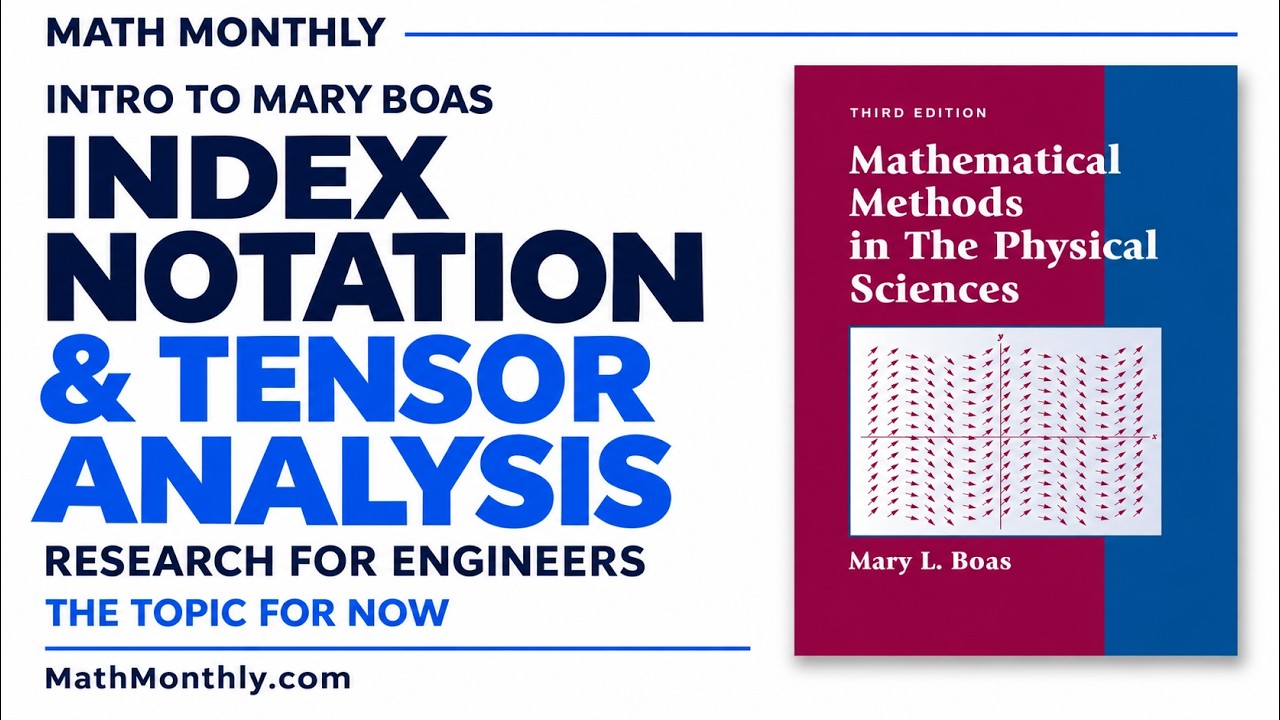
Intro to Mary Boas – Index Notation and Tensor Analysis Research for Engineers is the Topic for Now

This Is Where Tensor Analysis and Index Notation Begin – Mary Boas Textbook Review

Explore Mary L. Boas’s Mathematical Methods in the Physical Sciences as we introduce Cartesian tensors, index notation, and Einstein summation convention for Math Monthly’s engineering focus.

Get full access and perks when you become a member @MathMonthly via https://www.youtube.com/@TheAuthorJonathanDavid/join

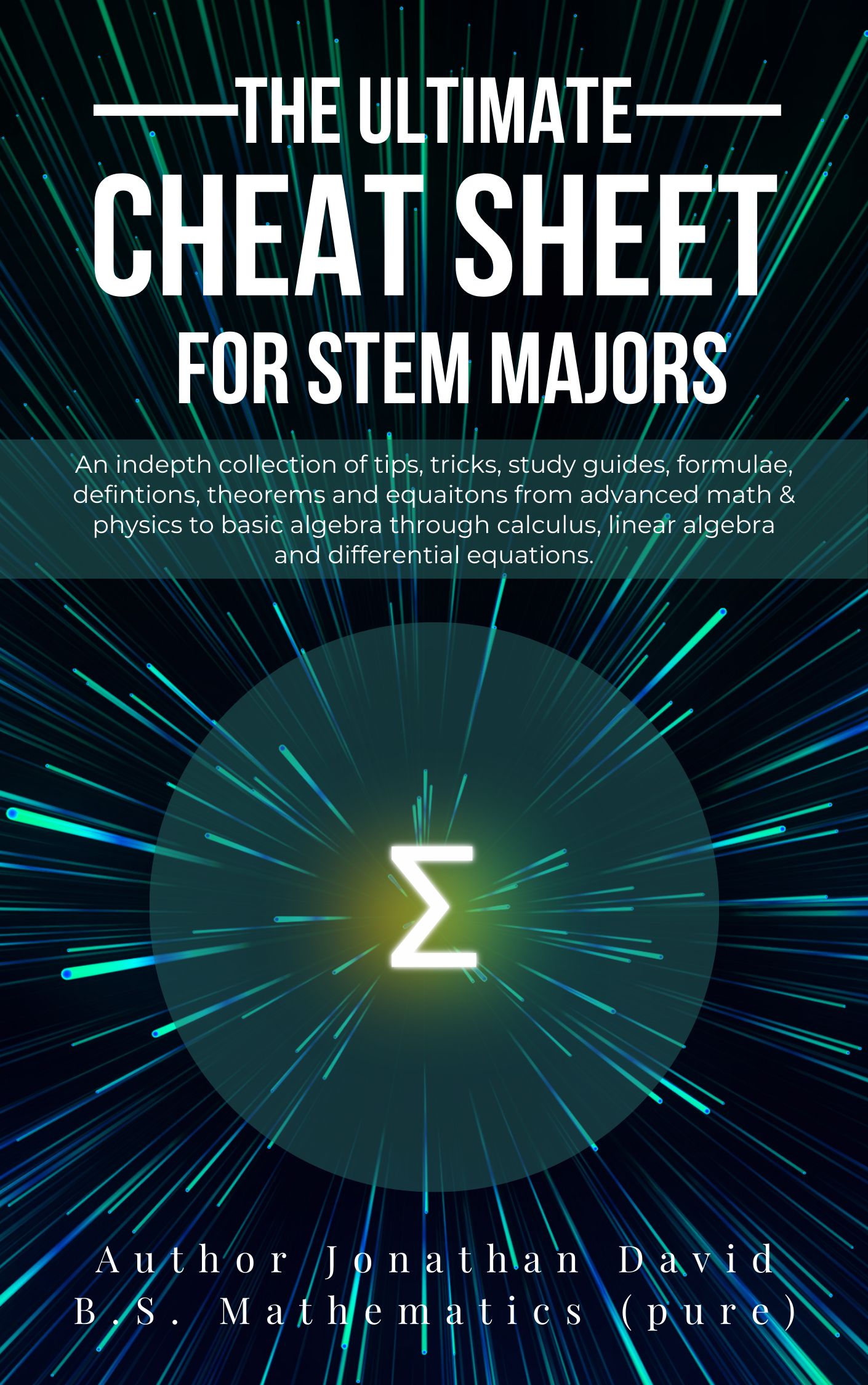
The Ultimate Cheat Sheets for STEM Majors (PDF Download)

Math Monthly — Inside the Book

Inside The Ultimate Cheat Sheet — Math Formulas, Tips, and Worked Examples

Take a look inside The Ultimate Cheat Sheet with Author Jonathan David. This walkthrough previews the subject-by-subject formula guides, explanations, and worked examples covering algebra, trigonometry, calculus, differential equations, linear algebra, and basic physics.


Watch the inside-the-book preview on YouTube ↗

Explore the Collection by Subject

Jonathan opens the individual subject guides and explains how their student-oriented presentation differs from the more formal writing in the Math Monthly journal.

  • Algebra and trigonometry formulas and reminders.
  • Differential, integral, and multivariable calculus material.
  • Common difficulties in differential equations and linear algebra.
  • Explanations, tips, and accompanying recordings of the writing process.

Original Transcript (punctuated)

Based on the supplied transcript. Punctuation and paragraph breaks have been added, with repeated fillers and false starts reduced for readability. Obvious transcription errors have been corrected, and unclear speech is marked where necessary.

All right, little boys and girls. I’m going to show you my Ultimate Cheat Sheet.

By the way, these are all the books you get in the Triple Play bundle. I’m going to find the one that has all the subjects in it. Where is it? Is it not here? I might have it in the other one.

Basic physics, linear algebra, one, two, three, four, five, Quartic Play, Math Monthly Edition One, How to Study in College. Where’s the full book? I must not have added it. I’ll have to add it.

That’s okay. We’ll look at all of them: college algebra, trigonometry, differential calculus, integral calculus, several-variable or multivariable calculus, differential equations, linear algebra, basic physics, and How to Study.

How to Study is the first book in the collection. I had them consolidated. You can open Adobe and consolidate them if you want. I didn’t realize I hadn’t put the combined version in there. I’ll find it and add it.

I’ll cover the How to Study guide in another video because that’s also a book people often buy separately.

I’ll show you these, starting with algebra. Look at how the covers have evolved. My cover-making skills have evolved over the years.

If you purchase the Triple Play bundle for $99, you get a lifetime access code to these videos on my website.

There are about 900 to 1,000 videos, something like that: 200 to 300 podcasts and 600 to 700 videos of me writing the books.

You can type in “limits,” or whatever you’re looking for. Most of them show me writing these books.

Here’s one of me writing the book. For those saying, “You used AI”—“Mom, Sunny D!”—here’s the video of me writing a freaking book, you little twerp. Okay, God.

This is what it looks like. The cheat sheet books are really formula books. It isn’t a cheat sheet so much as a list of formulas.

I put together what you’re supposed to have in your brain. You’re supposed to memorize this through doing problems repeatedly. This is just the algebra book.

Here’s the calculus collection, including different limit situations, integrals, and integration material.

Several-variable calculus is the same idea, with several variables. Pretty cool.

This is useful because people get confused about a lot of this material. I include tips and tricks and show things people often miss.

Differential equations is here too. The differential equations and linear algebra books focus more on common problems people struggle with and how to solve them.

This is written from your point of view, not mine.

Let me show you the Math Monthly book. There’s a big difference. The journal is written differently, with a more professional organization. It’s for professionals to read and develop their understanding.

These guides are written from the perspective of a freshman or sophomore student.

The feedback I’ve received from students is that, as they turn the pages, they keep saying, “Ah, that’s what that was. That’s what that was.”

I spent 15 years tutoring students, so I know what you’re thinking. I put it together for you.

Here you go. It’s reasonably priced. I lowered the price drastically, and I hope you purchase it and enjoy it. Have a nice—[recording ends].

AI Summarization

Author Jonathan David previews the individual subject guides that make up The Ultimate Cheat Sheet. He describes the collection as a formula reference supplemented by explanations, reminders, tips, and worked examples.

Subject Coverage

The walkthrough identifies algebra, trigonometry, differential calculus, integral calculus, multivariable calculus, differential equations, linear algebra, and basic physics. The How to Study guide is also identified as part of the collection.

Formulas & Common Difficulties

Jonathan describes gathering formulas and concepts students are expected to become familiar with through repeated practice. The differential equations and linear algebra guides are presented as focusing particularly on recurring difficulties and how to work through them.

Written for Early College Students

The explanations are intended to reflect the perspective of a freshman or sophomore. Jonathan contrasts this style with the more formal organization and presentation of the Math Monthly journal.

Individual & Combined Files

During the recording, Jonathan opens the individual subject files after being unable to locate a combined copy in the displayed collection. He says he intends to find and add the consolidated version.

Accompanying Lesson Library

The video also previews recordings of Jonathan writing the books. He describes a lifetime access code with the Triple Play purchase and gives approximate counts for the accompanying lesson recordings and podcasts.

The price, access terms, file availability, and approximate recording counts mentioned in the transcript reflect the speaker’s description at the time of recording. Consult the linked product pages for purchase details.

Books, PDF Bundle & Lesson Library

Explore my books and PDF bundle, which include access to a library of lessons.

Hardcover purchasers: Send me your purchase receipt to receive lesson library access.

Continue Exploring with Math Monthly

Explore mathematics, physics, and their connections to engineering with Author Jonathan David. Discover the available Math Monthly memberships and follow the development of new lessons and journal material.


View Math Monthly Memberships ↗

...

Math Monthly Journal Membership Required

You must be a Math Monthly Journal member to access this content.

Join Now

Already a member? Log in here

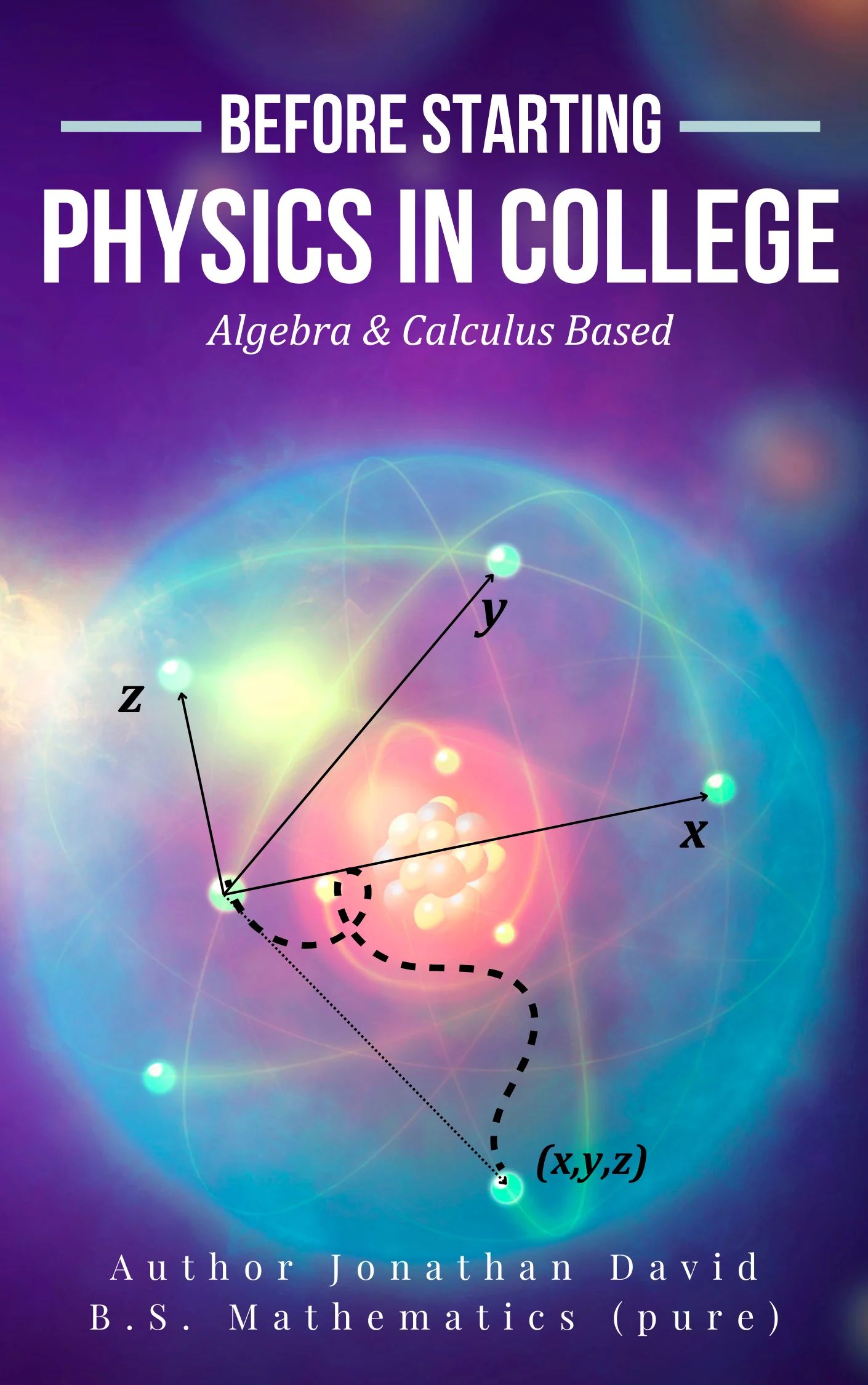
Before Starting Physics in College (Algebra or Calculus) PDF Download

Math Monthly — Inside the Book

Inside Before Starting Physics — Study Advice, Math Review & Physics Problems

Look inside Before Starting Physics with Author Jonathan David. This walkthrough previews the guide’s study advice, discussion of algebra-based and calculus-based physics, mathematical preparation, and introductory problem-solving examples.


Watch the inside-the-book preview on YouTube ↗

Preparing to Begin—or Return to—Physics

Jonathan opens the guide and explains how it moves from study preparation and course expectations into mathematical notation and worked physics problems.

  • Study advice and common misconceptions about learning physics.
  • Discussion of algebra-based and calculus-based courses.
  • Selected algebra, trigonometry, and calculus preparation.
  • Problem-solving approaches and introductory physics examples.

Original Transcript (punctuated)

Based on the supplied transcript. Punctuation and paragraph breaks have been added, with repeated fillers and false starts reduced for readability. Unclear speech is marked where necessary. Product descriptions, estimates, and opinions remain the speaker’s.

Okay, kids. I’m going to show you a look inside the Before Starting Physics book. Did I download it? Basic Physics—no, I didn’t. Let me download it.

Before Starting Physics is right here.

Just so you know, if you purchase the Triple Play bundle for $99, you get access to around 900 videos of me writing these books.

For those saying, “You used AI,” no—there are about 600 videos of me writing the freaking book. My God.

The first half of Before Starting Physics is literature explaining studying physics and addressing misconceptions to straighten your thinking out.

I explain the differences between high school physics, college physics, and university physics—algebra-based versus calculus-based physics.

Then, around here, I show what you need from algebra, what you might need from trigonometry, and what you might need from calculus.

I go into how to approach problem solving. Here are more calculus-related things connected with what you’ll do.

Toward the end, we get into actual physics problems.

If you’re taking calculus-based physics, you’re not going to do much calculus, if any at all. I show the notation and how it works so it isn’t confusing.

That’s pretty much it. It isn’t a huge book. It’s about 80 textbook-sized pages, at least half written in mathematical code.

If you reduced it to a normal book size, it would be about 160 pages. If you expanded the code, it would be a fairly regular novel-sized book.

If you’re in college, about to begin, or returning to college, it isn’t a long read. It’ll change your life.

It documents what I went through and figured out, what I observed tutoring for 15 years, and what I saw when students used things like Khan Academy, AI, and private tutors and failed.

It’s intended to prevent that. If you’re serious about your education, this literature will reshape your thinking toward success.

That’s the response I’ve received from students who read the How to Study guide and Before Starting Physics. They say, “I’m ready to go. You’re right.”

The Ultimate Crash Course and The Ultimate Cheat Sheet are there to help ensure you understand what you need by junior year.

Cumulatively, it’s about 2,000 pages or something. I don’t know. And hundreds of videos—$99 for all that is a good deal.

I’d say about 900 recordings: around 300 podcasts and 600 or 700 video lessons.

It should be more expensive, but there isn’t a huge market, and interested college students often don’t have much money. I lowered the price significantly and put it into a bundle.

It’s a $99 one-time fee. You receive an access code to my work on this website, including the fiction.

Come to the front page. You can also go to—[unclear website name]—it’s the same thing. It’s $99 for the books and everything.

I tested the pricing, and it is what it is.

Some old cooking shows and other material are here, along with the fiction books. It’s worth the investment. You’ll be entertained and educated for a long time.

Enjoy. I’m moving on to the Math Monthly journal, doing math and physics every day with people and focusing on that.

If you want to develop your knowledge and prepare your résumé, joining the Math Monthly journal research program could be beneficial to your future and a lot of fun.

Thanks for watching. This is—[recording ends].

AI Summarization

Author Jonathan David provides an inside look at Before Starting Physics, describing its progression from study guidance to mathematical preparation and physics problem-solving examples.

Study Preparation

The opening portion discusses studying physics and addresses misconceptions Jonathan has observed through his own education and tutoring experience. The intended readers include students beginning college, current students, and adults returning to study.

Course Formats & Mathematical Background

The guide discusses algebra-based and calculus-based physics, then introduces selected material from algebra, trigonometry, and calculus. Jonathan emphasizes explaining notation so readers can approach the later examples with greater familiarity.

Problem-Solving Examples

Later sections move into approaches to problem solving and actual physics questions. The walkthrough presents the guide as a compact preparation resource rather than a comprehensive physics textbook.

The Broader Collection

Jonathan places the guide alongside the How to Study material, The Ultimate Crash Course, and The Ultimate Cheat Sheet. He also describes access to an accompanying library of lesson recordings, podcasts, and other work through the Triple Play bundle.

Continuing with Math Monthly

The video closes with Jonathan describing his shift toward the Math Monthly journal and collaborative mathematics and physics sessions. He presents participation as an opportunity to explore topics, develop skills, and contribute to the ongoing work.

Page counts, recording totals, and pricing are estimates or offers described in the recording. Consult the linked product pages for purchase details. The amount of calculus used in a physics course depends on its syllabus and level.

Books, PDF Bundle & Lesson Library

Explore my books and PDF bundle, which include access to a library of lessons.

Hardcover purchasers: Send me your purchase receipt to receive lesson library access.

Continue Exploring with Math Monthly

Explore mathematics, physics, and their connections to engineering with Author Jonathan David. Discover the available Math Monthly memberships and follow the development of new lessons and journal material.


View Math Monthly Memberships ↗

...

Math Monthly Journal Membership Required

You must be a Math Monthly Journal member to access this content.

Join Now

Already a member? Log in here

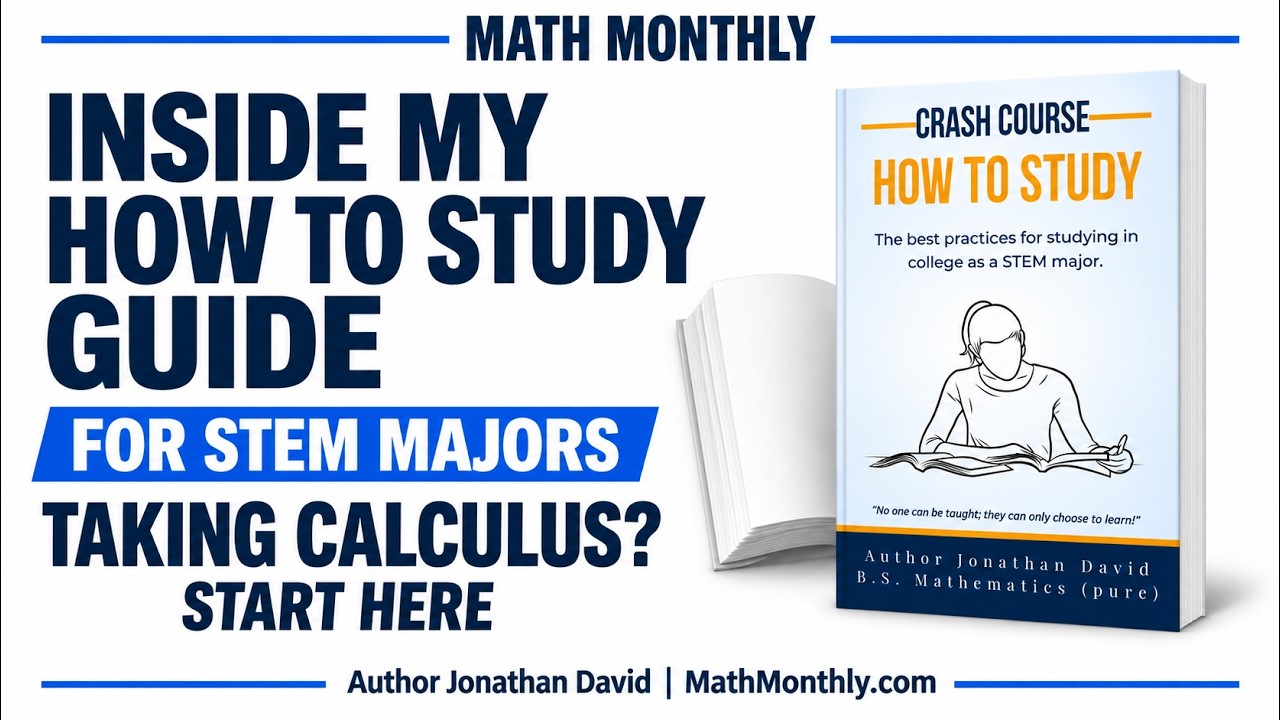
How to Study Crash Course PDF

Math Monthly — Study Skills & Career Preparation

How to Study in College and Prepare for Employment — Inside the Guide

Author Jonathan David introduces his How to Study in College guide, developed from his experiences in employment, college coursework, and private tutoring. This preview discusses textbook notes, mathematical writing, exam preparation, and the connection between studying and developing practical skills.


Watch this study guide introduction on YouTube ↗

What the Guide Discusses

  • Preparing to begin a STEM degree and college mathematics.
  • Taking notes from a university physics textbook.
  • Structuring mathematics and physics solutions clearly.
  • Distinguishing the learning process from exam performance.
  • Using technology and developing skills beyond an individual course grade.

Original Transcript (punctuated)

Based on the supplied transcript. Punctuation and paragraph breaks have been added, with repeated fillers and false starts reduced for readability. Unclear speech is marked where necessary. The speaker’s opinions, product descriptions, and recollections are retained.

Hola, everybody. This book is How to Study in College and Land a Job Before Your Graduation.

I wrote it based on personal work experience before college. I’ve been employed since I was young and worked full time in sales.

I tried business school and psychiatry school. I didn’t finish those, obviously, but I attempted different things in my life. Then I tutored people for about 15 years.

I watched students fail and succeed, had my own experiences, worked professionally, ran businesses, and completed more than 220 college credit hours.

I put this little book together. It’s a little gem called How to Study in College.

It’s primarily for STEM majors. If you have to take calculus, this book is for you.

I discuss preparing for mathematics and show how to structure solutions in mathematics and physics.

I explain writing exam solutions for maximum credit and understanding the difference between learning and taking an exam.

There are strategies in college. It’s more than taking a course and earning a GPA.

I think GPA is a trick of the mind for STEM majors, particularly the mathematics, physics, and engineering students I usually address. Chemistry or medicine is a different situation.

I compare it with IQ tests. I don’t believe one person can determine another person’s intellect through a test. If you think that number establishes your intellect, I think you’ve missed the point.

Here’s an example of taking notes from a physics textbook. It’s a real example using University Physics. I collected words and equations from the book and show how to organize them.

I discuss proper studying and related topics. This is part of the Triple Play bundle.

The bundle is designed to repair damage from relying on internet resources instead of developing your own education.

Read the code of conduct and syllabus. Use the textbook and attend lecture.

That isn’t an ancient approach to learning. It’s like stretching and lifting weights to prepare for football. You can’t step onto the field without developing strength.

College is the gym for your brain. These exercise problems have already been solved. Getting someone else or a tool to solve them isn’t impressive.

If you aren’t willing to lift the weights, don’t go to the gym.

This book is intended to make that clear. People have read it and told me, “Thank you. I get it now.”

It’s a short read: about 52 textbook-sized pages in this version, or about a hundred pages at a smaller book size.

Personally, I would have it read aloud. I plan to make an audiobook, perhaps beginning today. I need to get the book from storage.

It’s important to have a reality check. You can damage your education by arguing that you already know everything when you lack experience.

You’re in college because you’re inexperienced, uneducated, and preparing to become employable.

If you argue with someone experienced, educated, and employable, I think you’re in the wrong place and need help.

This book is meant to help crack that shell.

This is an introduction so you can see what it looks like. It covers preparing for a STEM degree, preparing for mathematics, titling and writing work, treating a mathematics question like an essay, technology, maximizing points, and studying.

If you purchase the Triple Play bundle, it comes with about a thousand recordings.

I’ll show you at—[unclear website name]. It’s $99 for the books and related material, perhaps around 2,000 pages, plus roughly 200 to 300 podcasts and about 700 videos of me writing the books.

This is material from my original YouTube channel. I later realized I needed to change the message, but I still consider the literature valuable for STEM majors taking calculus.

The bundle is intended either to prepare you for college or help repair gaps after relying on Khan Academy, Wyzant tutoring, ChatGPT, AI, or pirated solution manuals.

If you reach junior year without knowing how to navigate a textbook, you’re in trouble. This material is meant to help.

That was the older mission. The videos are available through a one-time purchase, or you can pay monthly if you prefer.

My new mission is the research program and the structure I’m building on the website.

I take a book and make a crash course with one question from each section, showing how to use the textbook.

It isn’t just about solving a problem. It’s about reading the textbook. Once you see the process, you can repeat it.

Members will have a Q&A area. If I haven’t covered a section, you can request it.

I’ll be launching that—[recording ends].

AI Summarization

Author Jonathan David introduces his How to Study in College guide and previews its contents. He describes developing it from employment, college coursework, and approximately 15 years of tutoring experience.

Preparing for STEM Coursework

The guide is directed particularly toward students taking calculus and those studying mathematics, physics, or engineering. Jonathan presents it as preparation for college study and as a resource for reconsidering ineffective habits.

Textbook Notes & Mathematical Writing

The preview includes notes drawn from a university physics textbook, vocabulary and equations, and explanations of how to structure written work. Jonathan emphasizes treating mathematical solutions as organized explanations rather than isolated calculations.

Learning vs. Taking an Exam

Jonathan distinguishes developing understanding from presenting work under exam conditions. He identifies solution structure, point allocation, and preparation as topics in the guide.

Practice as Intellectual Exercise

Comparing coursework with physical training, Jonathan argues that students need to perform the intellectual work themselves. His central concern is the difference between obtaining a completed answer and building independent capability.

The Book & Accompanying Recordings

The guide is described as part of the Triple Play bundle, alongside other books, podcasts, and recordings of the writing process. Jonathan also mentions plans for an audiobook.

The Next Stage — Math Monthly

Jonathan contrasts the earlier collection with his current research program and textbook demonstrations. He describes plans for member requests concerning sections not yet represented in the lesson collection.

Page counts, recording totals, prices, and planned features reflect the speaker’s description at the time of recording. The guide’s employment-focused title does not guarantee a job before graduation, and permitted learning resources depend on the applicable course instructions.

Continue Exploring with Math Monthly

Explore mathematics, physics, and their connections to engineering with Author Jonathan David. Discover the available memberships and follow the development of new lessons and journal material.


View Math Monthly Memberships ↗

...

Math Monthly Journal Membership Required

You must be a Math Monthly Journal member to access this content.

Join Now

Already a member? Log in here

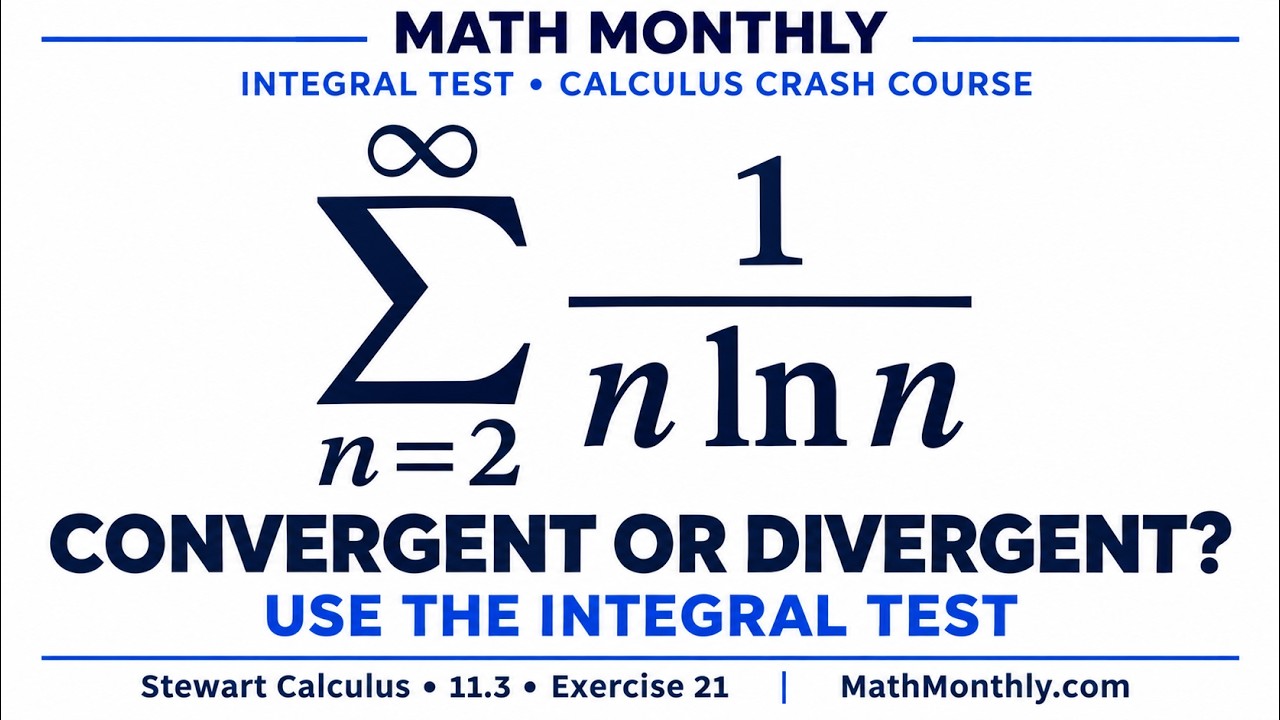
11.3 Integral Test – Does ∑ 1/(n ln n) Converge or Diverge?

Apply the integral test to ∑ₙ₌₂∞ 1/(n ln n), checking continuity, positivity, and decreasing behavior before evaluating the improper integral.

Textbook reference: James Stewart, Calculus: Early Transcendentals, 8th edition, Cengage Learning, Section 11.3, Exercise 21.

Get full access and perks when you become a member @MathMonthly via https://www.youtube.com/@TheAuthorJonathanDavid/join