

Get full access and perks when you become a member @MathMonthly via https://www.youtube.com/@TheAuthorJonathanDavid/joinExplore the journal and research program at https://MathMonthly.com.
Math Monthly
717 posts

Get full access and perks when you become a member @MathMonthly via https://www.youtube.com/@TheAuthorJonathanDavid/joinExplore the journal and research program at https://MathMonthly.com.Explore the journal and research program at https://MathMonthly.com.

Get full access and perks when you become a member @MathMonthly via https://www.youtube.com/@TheAuthorJonathanDavid/joinExplore the journal and research program at https://MathMonthly.com.

What happens when you take the dot product of a 3D vector with itself? In Lesson 3 of the Math Monthly Journal’s index notation series, Author Jonathan David expands the product into nine terms and uses the orthonormal basis to show why six vanish. The three remaining terms give the sum of the squared components, which is the squared length of the vector.
This example shows how a double sum reduces to a single sum and sets up the next lesson on inner products.
Get full access and perks when you become a member @MathMonthly via https://www.youtube.com/@TheAuthorJonathanDavid/join

Author Jonathan David · Math Monthly Journal · Index Notation Lesson 2 · Watch on YouTube From a Column Vector to a Row Vector In Lesson 1, we wrote a three-dimensional column vector in index notation. In Lesson 2, we transpose that vector and write the resulting row as a […]

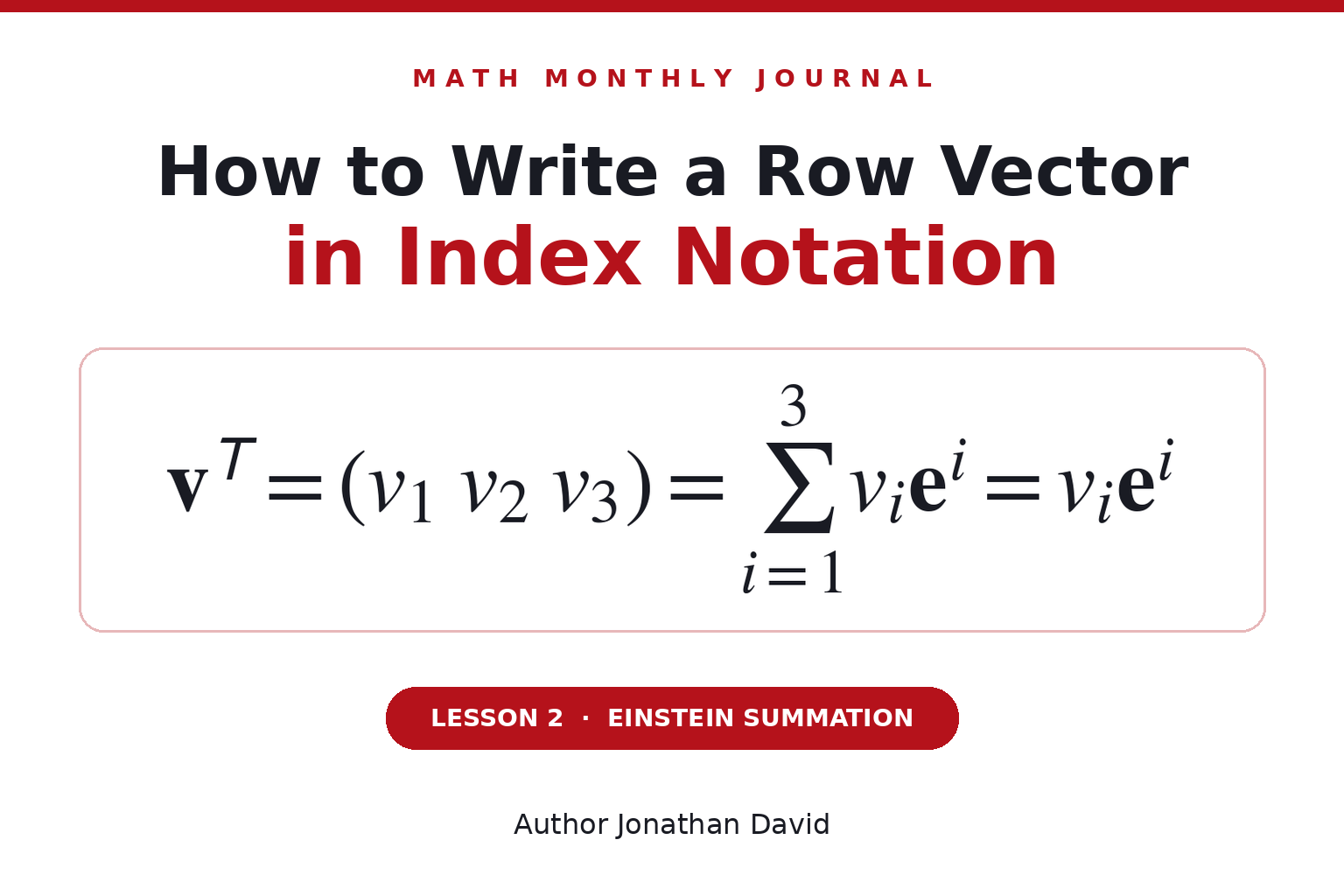
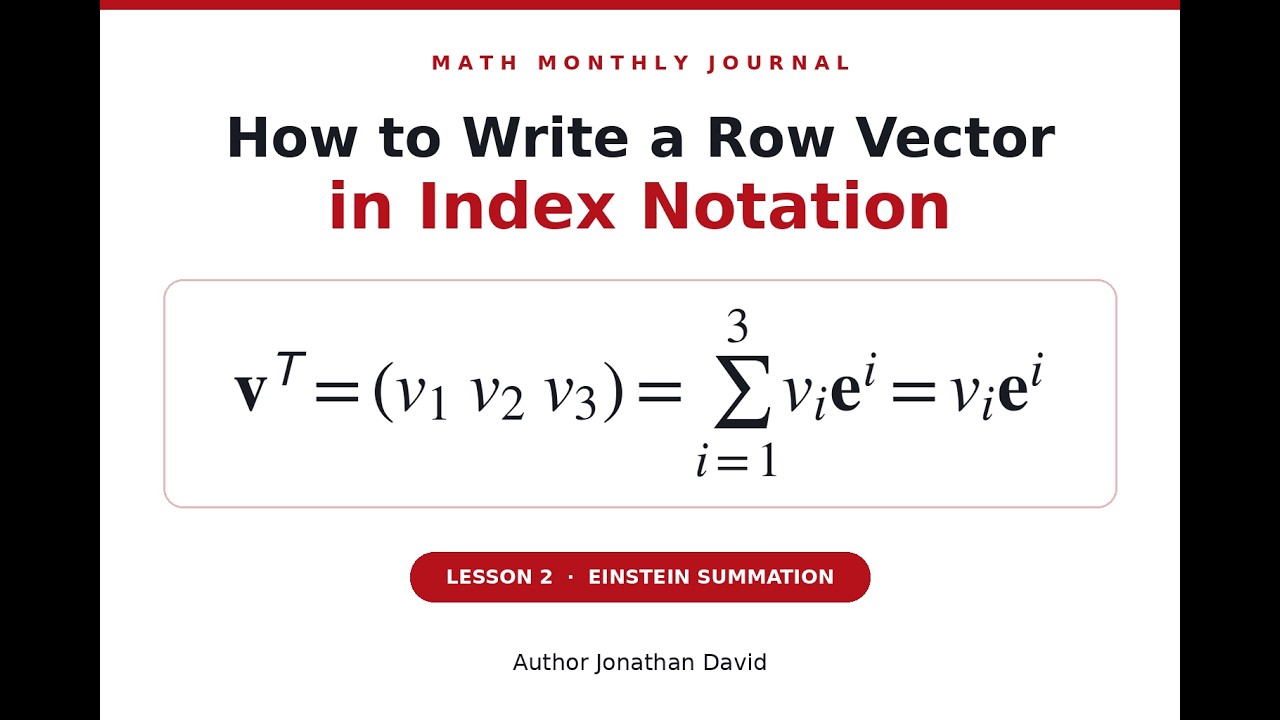
In Lesson 2 of the Math Monthly Journal’s index notation series, Author Jonathan David starts with a three-dimensional column vector, takes its transpose, and writes the resulting row vector as a sum of row basis vectors. Then he uses Einstein summation convention to write the same expression without the summation sign.
The lesson explains why this series uses upper indices on the row basis vectors and how defining that convention now prepares you for vector products and tensor analysis.
Get full access and perks when you become a member @MathMonthly via https://www.youtube.com/@TheAuthorJonathanDavid/join

Get full access and perks when you become a member @MathMonthly via https://www.youtube.com/@TheAuthorJonathanDavid/joinExplore the journal and research program at https://MathMonthly.com.

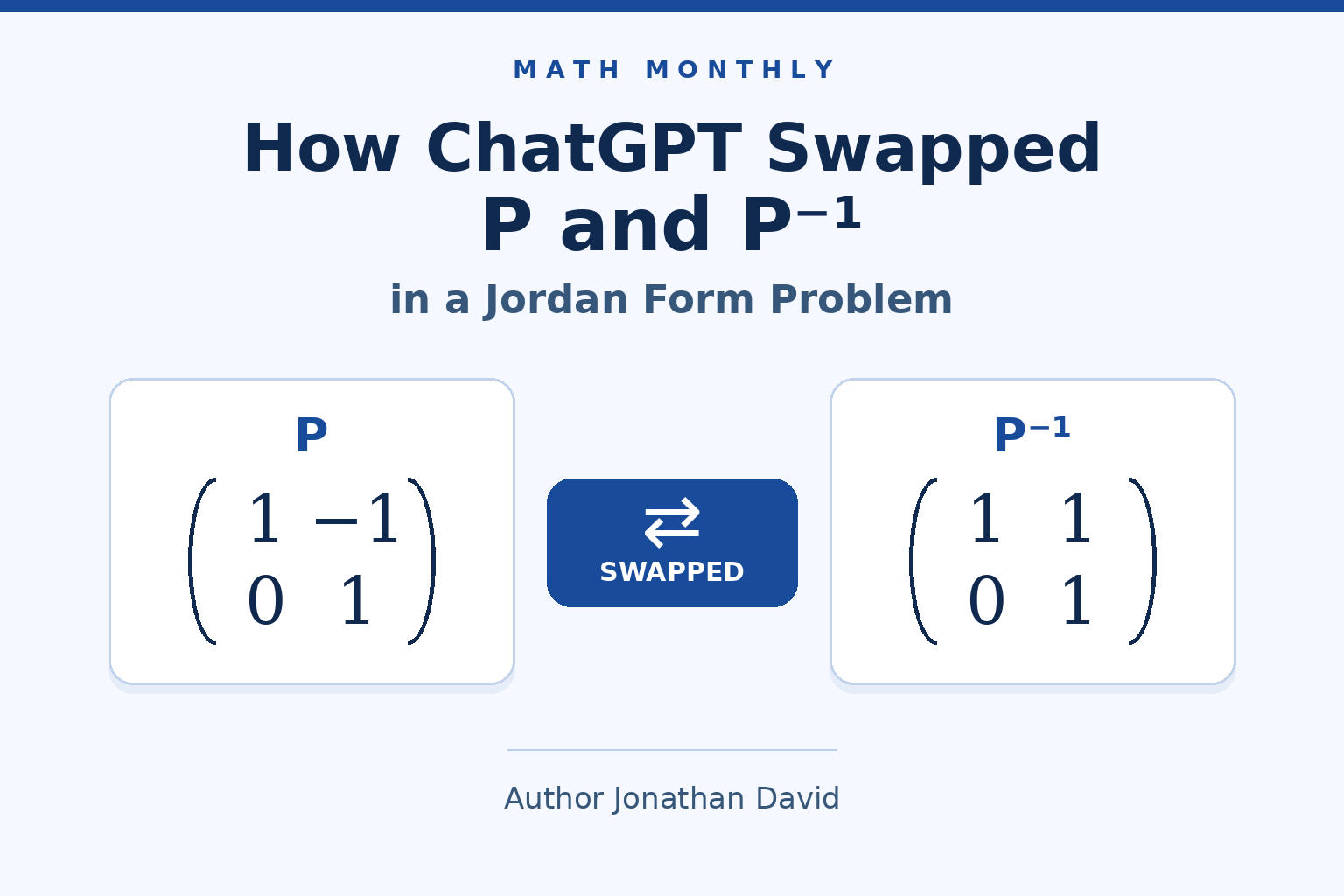
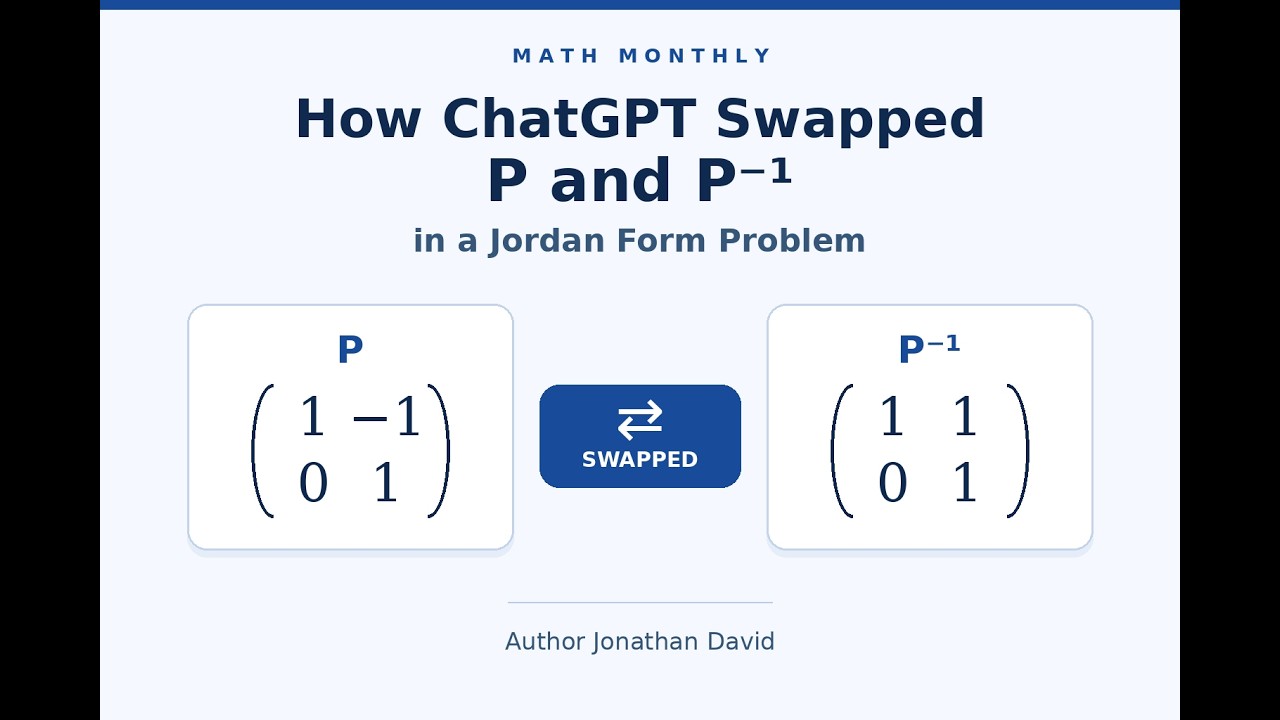
Author Jonathan David · Math Monthly · Watch on YouTube What Happened in the Jordan Form Calculation In this video, I revisit a matrix exponential problem from the Math Monthly Research Program. I asked ChatGPT to mimic a Maple calculation, and it returned a change-of-basis matrix labeled $P$. Under the […]

ChatGPT gave two different results for the same Jordan form problem. When I asked it to mimic Maple, it labeled the inverse change-of-basis matrix as P. When I asked it to compute the Jordan form directly, it gave the correct result. I show how we caught the swap and checked the matrix exponential against the textbook’s formula.
Get full access and perks when you become a member @MathMonthly via https://www.youtube.com/@TheAuthorJonathanDavid/join






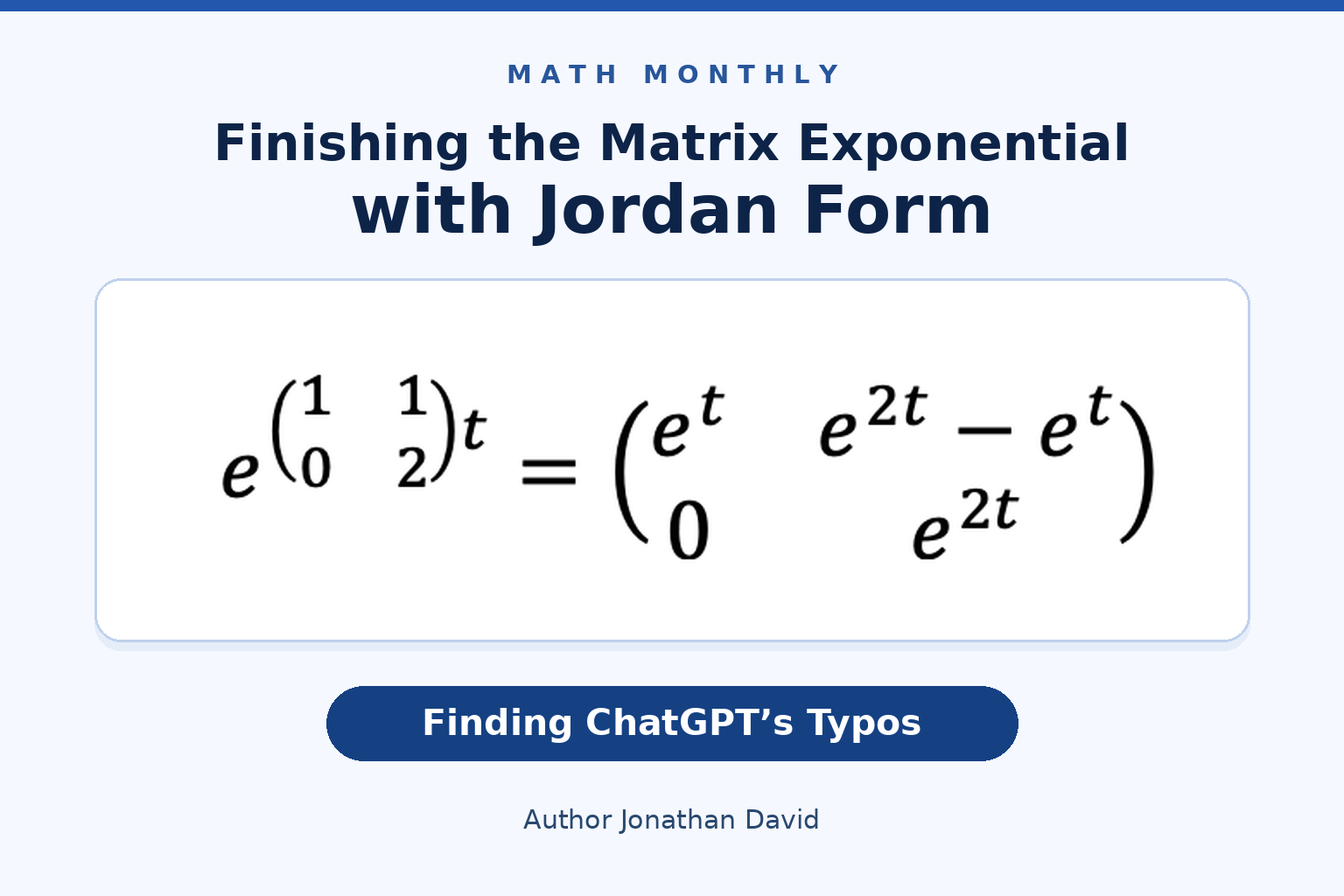
Author Jonathan David · Math Monthly · Watch on YouTube Written Lesson Book Source: Gustafson, G. B. (n.d.). Differential equations and linear algebra: A course for science and engineering (Vols. I–II). University of Utah. https://math.utah.edu/~gustafso/debook/deBookGG.pdf QUESTION 11.4.15 $$e^{\left(\begin{smallmatrix}1&1\\0&2\end{smallmatrix}\right)t}=\begin{pmatrix}e^t&e^{2t}-e^t\\0&e^{2t}\end{pmatrix}$$ ANSWER [There does not appear to be any answers in this text.] […]