Using the Euclidean Algorithm to Find the Greatest Common Divisor – Number Theory Example
This lesson is nothing more than a free preview of The Ultimate Crash Course for STEM Majors. This number theory example demonstrates how to use the Euclidean Algorithm to find the greatest common divisor of 875 and 4075 by identifying the successive quotients and remainders.
Explore The Ultimate Crash Course for STEM Majors
I also write fiction. Visit AuthorJond.com to explore my fiction, books, stories, and other writing.
Question 1.
Use the Euclidean Algorithm to find the greatest common divisor of 875 and 4075.
Theorem 3. The Euclidean Algorithm. If $a$ and $b$ are positive integers, $b\neq 0$, and
then for $k$ large enough, say $k=t$, we have
and $(a,b)=r_t$.
Let $a=4075,\ b=875$.
Then,
Then,
Then,
Then,
Then,
By The Euclidean Algorithm, $r_3=r_t=25$.
Thus,
For Q2
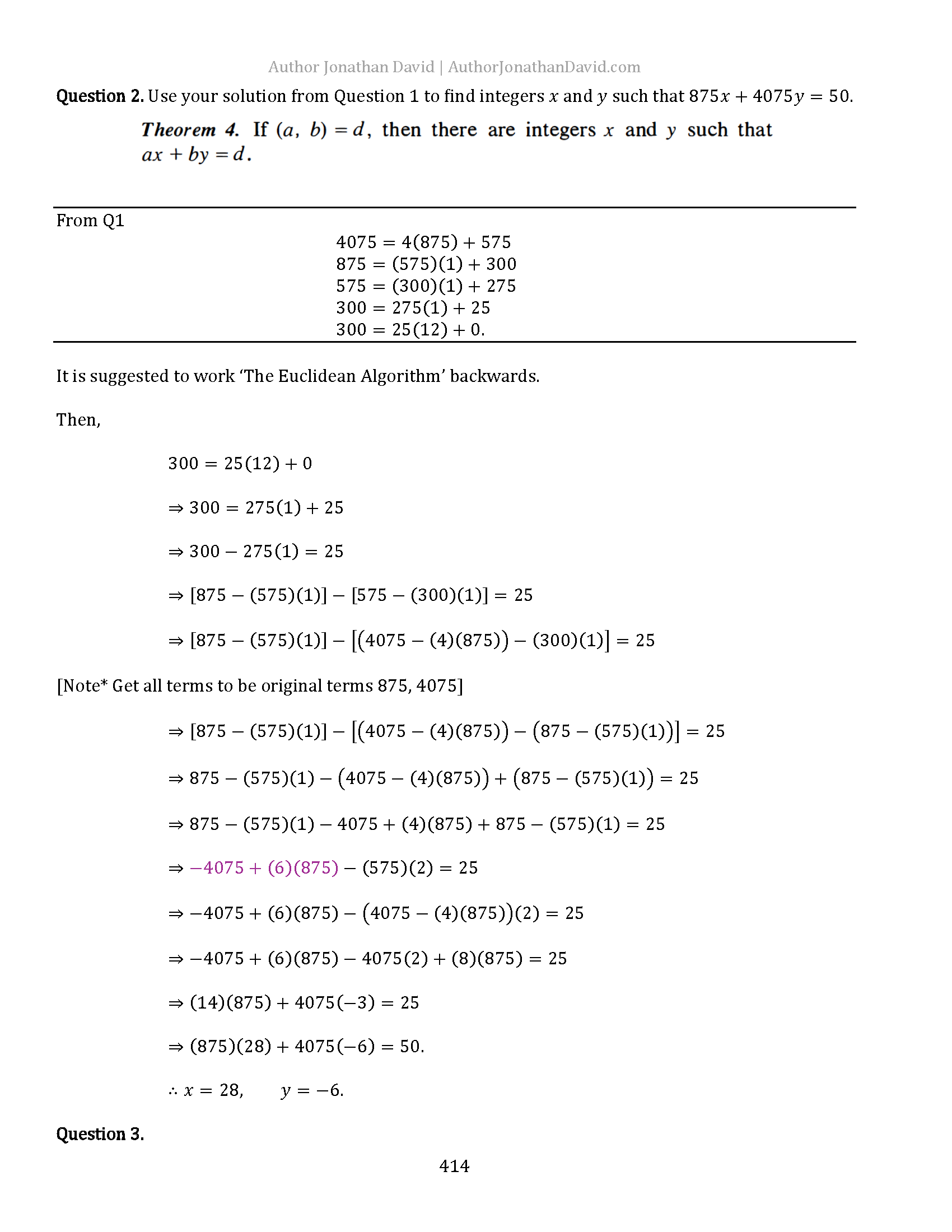
Question 2. Use your solution from Question 1 to find integers $x$ and $y$ such that $875x+4075y=50$.
Theorem 4. If $(a,b)=d$, then there are integers $x$ and $y$ such that
From Q1
It is suggested to work ‘The Euclidean Algorithm’ backwards.
Then,
[Note* Get all terms to be original terms 875, 4075]
Question 3.
Continue The Ultimate Crash Course for STEM Majors
What you just read is nothing more than a free preview of The Ultimate Crash Course for STEM Majors. The complete Crash Course series contains additional worked examples covering the Euclidean Algorithm, greatest common divisors, number theory, algebra, calculus, differential equations, mathematics, physics, engineering, and other STEM subjects.
Get The Ultimate Crash Course for STEM Majors
I Write Fiction Too
If you enjoy my educational work and want to explore something completely different, visit AuthorJond.com to check out my fiction, books, stories, and other writing.