What Is PLEM Academy and How the Research Program Works
PLEM Academy is built around research participation, STEM preparation, technical communication, professional software skills, independent study, and long-term resume development. This introduction explains how the website, lessons, research sessions, books, certificates, and member-only materials fit together.
Building the PLEM Academy Library
A major part of PLEM Academy is organizing the growing collection of lessons, research sessions, crash-course volumes, college tips, and research material into a website that students can actually navigate.
Instead of relying entirely on social-media platforms, the primary material is organized through the website. Public videos can introduce a subject, while complete lessons, research material, PDFs, past live sessions, and member-only resources can be stored in a more structured environment.
Lessons can be categorized by subject, research project, volume, certificate, monthly publication, or live-session archive so that the material remains useful long after a livestream ends.
Public Content Versus Member-Only Research Sessions
Some PLEM Academy material is shared publicly as an introduction to the program. Other sessions are intentionally kept unlisted or restricted to members through the website.
This makes it possible to share samples publicly while preserving a more organized archive for the people actively participating in the research program.
A live session might begin on YouTube as a demonstration, but the complete version can later be organized on the website with its related transcript, article, PDF, research notes, and additional material.
Why the Website Matters
Social-media platforms are useful for discovery, but they are not ideal for organizing an educational program over many years.
A WordPress website allows lessons to be categorized, edited, updated, connected to membership levels, arranged into archives, and presented alongside research material.
Students participating in the program also gain exposure to how a real WordPress website is built and maintained.
That includes experience with:
- WordPress posts and pages
- Categories and archives
- Membership restrictions
- Featured images and thumbnails
- HTML formatting
- Mathematical typesetting
- Video embedding
- Research and publication workflows
PLEM Academy Is More Than a Video Library
The program is not designed simply to produce an enormous collection of videos.
The larger objective is to connect several activities that STEM students frequently encounter separately:
- Mathematics and physics problem solving
- Reading technical textbooks
- Research participation
- Professional document creation
- Scientific communication
- Website development
- Resume development
- Publishing and long-term project organization
A student can therefore learn calculus while simultaneously practicing the software, communication, organizational, and research skills that may become useful later in a professional setting.
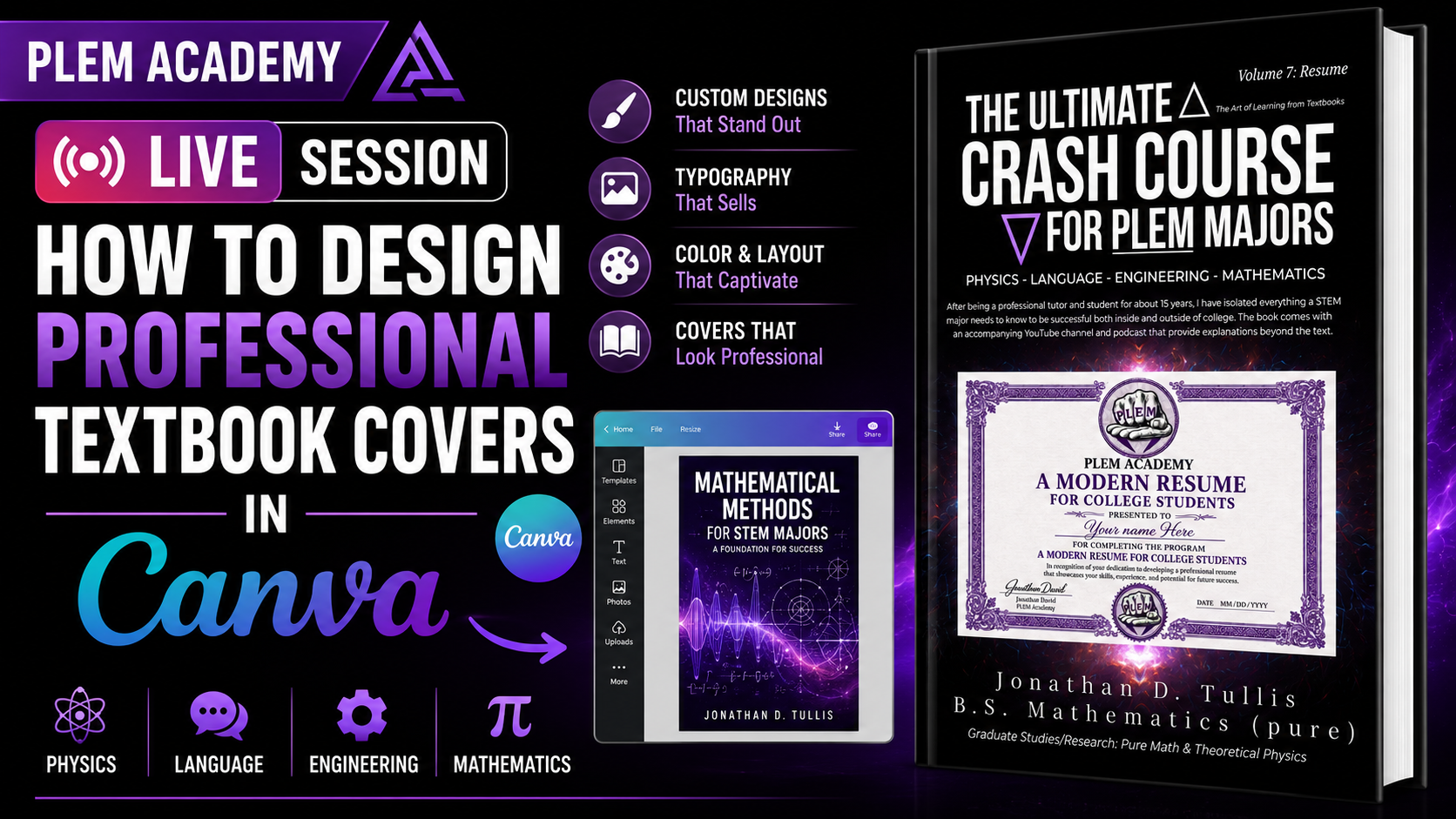
The Ultimate Crash Course Series
One of the major projects being developed through PLEM Academy is a multi-volume STEM crash-course series.
Different volumes address different levels and areas of study. The material grows over time as new lessons, research sessions, examples, notes, and revisions are added.
Instead of waiting until every book is completely finished before allowing students to participate, developing material can be used during the research process itself.
That gives research participants an opportunity to see how educational material changes from an early working version into an edited publication.
Math Monthly
Another part of the program is the Math Monthly project.
Material produced during the month can be compiled into a larger edition containing lessons, mathematics, research material, corrections, and developing content from the program.
Members can review these materials digitally, and depending on the membership option, physical material may also be included in periodic mailers.
Early versions can contain material that is still being reviewed, which gives participants an opportunity to develop an eye for detail by identifying typos, mathematical issues, formatting problems, or areas that could be clarified.
Why Research Participants Review the Material
Research participation is not limited to watching a livestream.
Students can return to the completed lesson and review the corresponding article, mathematical document, or publication draft.
The purpose is to practice the kind of attention to detail required when communicating scientific and mathematical material professionally.
That might involve checking:
- Mathematical notation
- Arithmetic
- Definitions
- Units
- Formatting
- Spelling and grammar
- Citation and attribution
- Whether the written explanation matches the mathematical work
Learn Microsoft Word, HTML, WordPress, and Mathematical Typesetting Together
A research participant may write an original response or correction in Microsoft Word and then convert that material into the appropriate format for the website.
This creates a practical reason to learn several tools together rather than studying software in isolation.
A typical workflow might look like this:
- Review the research lesson.
- Identify an issue, correction, or useful observation.
- Write the response originally in Microsoft Word.
- Use AI as a formatting assistant when appropriate.
- Convert the response into HTML and Jetpack LaTeX for WordPress.
- Submit the response through the research website.
The intellectual work remains the researcher’s own. Technology is being used to help translate that work between different professional formats.
Certificates and Research Credit
The program also connects participation with professional development.
Research work can contribute toward experience in scientific communication, modern web development, resume building, and research participation.
The objective is to give students something more substantial than simply saying they watched educational videos.
Students can instead point to actual activities involving technical writing, reviewing mathematical material, working with professional software, participating in research sessions, and contributing to developing publications.
Build Skills That Belong on a Resume
One of the central ideas behind PLEM Academy is that students should think about their future resume while they are still in college.
Coursework is important, but students also need experiences that demonstrate what they can actually do.
Examples of Skills Developed Through the Program
- Microsoft Office
- Scientific and mathematical communication
- WordPress
- HTML
- Mathematical typesetting
- AI-assisted professional workflows
- Research review
- Publishing workflows
- Independent project organization
Research Sessions Can Become Published Work
The lessons produced through live research sessions are not necessarily isolated events.
They can eventually become part of a larger publication.
That creates a complete cycle:
Students who participate in that process gain exposure to the way a long-term technical project evolves rather than seeing only the final polished product.
Why Some Sessions Are Unlisted
Not every live session needs to remain public on YouTube.
Some recordings can be kept unlisted and embedded directly into the member website. That keeps the public channel more focused while still preserving the complete session for participants.
It also allows the lesson to be surrounded by supporting material rather than appearing as an isolated video.
A member can see the recording, written explanation, related PDF, publication draft, or research instructions together in one location.
Organization Is Part of Professional Development
A recurring theme throughout the session is organization.
Books need categories. Videos need titles. Research sessions need archives. Publications need versions. Website material needs featured images. Member-only content needs the correct access settings.
None of those individual tasks seems especially profound, but together they demonstrate something important: professional work requires systems.
Learning to maintain those systems is part of becoming capable of managing larger technical projects.
Set a Limit on Your Daily Work
Another useful idea discussed during the session was creating a stopping point for the workday.
There will always be another page to edit, another video to organize, another article to write, another lesson to review, and another improvement to make.
Setting a measurable daily objective can prevent a project from consuming every available hour.
The exact number does not matter as much as the principle:
Finish the planned work, document your progress, and stop. Sustainable productivity is usually more valuable than endlessly expanding the day’s workload.
The Bigger Idea Behind PLEM Academy
PLEM Academy is ultimately an attempt to connect education with the work students may eventually be expected to perform professionally.
You can study mathematics while learning how to communicate mathematics. You can study physics while learning how to publish technical material. You can participate in research while learning how websites, documents, books, and professional projects are organized.
The objective is not simply to accumulate information.
The objective is to become capable of using information.
Learn. Research. Communicate. Build.
The mathematics and physics are one part of the process. The research, communication, software, publishing, organization, and professional development surrounding that work are what turn coursework into experience.
Join the PLEM Academy Research Position
The PLEM Academy Research Position is designed for students who want to participate in developing mathematics, physics, engineering, research, textbook, and professional communication projects rather than simply watching lessons.
Participants can gain experience reviewing developing publications, working with Microsoft Word, HTML, WordPress, mathematical typesetting, research communication, and other tools that can contribute to a stronger STEM resume.
Depending on the membership option, members may also receive monthly or quarterly educational mailers, developing books, Math Monthly material, research resources, and other bonus content.
Readers interested in Jonathan David’s independent fiction and publishing projects can also explore the Fiction Fan Club for books, mailers, handmade material, and additional member bonuses.